What Do We Owe The Dead?
I am back from my walk along Offa's Dyke! And I have recorded the first story since I've been back.The Death Mask (1920) by Henrietta Dorothy Everett (1851-1923)
"The Death Mask" was first published in 1920 as the title story of The Death-Mask and Other Ghosts (London: Philip Allan, Quality Court, Chancery Lane), a collection of ten supernatural tales issued under the name Mrs. H. D. Everett. It was Everett's final collection and her first to appear under her own name rather than the male pseudonym "Theo Douglas" she had employed since her debut in 1896.
"The Death Mask" is, beneath its supernatural machinery, a story about ethical debt. Tom Enderby did not love his first wife. The marriage had the shape of a convenience — Gloriana was his senior, the house was hers, and when she died his first private thought was "a good job too." He pocketed that relief without examination, without mourning, without any honest reckoning with what the marriage had actually been or what it had cost the woman who invested her entire legal and social identity in it while he merely endured it. He then walked straight toward Lucy Ashcroft as though the first marriage had left no account outstanding. The haunting is that account presenting itself for settlement.
There is a psychoanalytic dimension to this that Freud's account of repression makes precise. The death-mask does not appear as conscious guilt — Tom is not a man visibly tormented by his treatment of Gloriana. What is intolerable to consciousness is not destroyed but displaced, and returns in distorted form. The ghost is the symptom of a repression that is ethical in origin, which is why it manifests not in Tom's dreams or his private moments but specifically and only when he is actively pursuing remarriage. The haunting is triggered by the attempt to move forward without having settled the account, and it takes its form — white linen, the substance of Gloriana's domestic labour, the material she managed invisibly throughout their marriage — from the precise nature of the debt. Tom wore the clean shirts, sat at the laid table, used the handkerchief. He never once registered any of it as labour performed for him, as obligation incurred, as a ledger that was running. The linen is not only a haunting medium. It is the debt made visible in the only form it ever took in life — the form he never looked at and never counted.
This pattern — the dead or displaced wife whose unprocessed claim prevents the husband from finding happiness with a second woman — runs through a specific and coherent literary tradition. In Charlotte Brontë's Jane Eyre (1847) Bertha Mason is the institutionally prior wife whose existence cannot be wished away, the claim that must be violently destroyed before the second marriage can even begin. In Hugh Walpole's "Snow" (1910) Jacob Finch walks willingly into the cold where his dead wife waits, choosing the exemption from genuine feeling she offers over the demands the living second wife makes on him — the haunting here is as much temptation as punishment, because the inauthenticity of the first marriage offered a kind of cold safety that authentic love does not. In Edith Wharton's "The Pomegranate Seed" (1931) Kenneth Ashby cannot stop opening his dead wife's letters because something in the first marriage was never honestly closed, and his silence with his second wife Loring is not discretion but the continuation of an inauthenticity that has simply transferred itself forward. In Daphne du Maurier's Rebecca (1938) Maxim de Winter has built his second marriage on a suppressed history that makes honest intimacy structurally impossible — the entire first marriage was a mutual performance of a domestic ideal neither party believed in, and its monument, Manderley, is a house in which no genuine self was ever permitted to exist.
What these texts share is a single insight: the dead wife's power is not supernatural in origin. It is ethical. These men contracted marriages that were not grounded in genuine feeling, suppressed the knowledge of what they had done, and expected to move forward unencumbered. The ghost is the form that unfinished business takes when it can no longer be deferred. In every case the second wife or fiancée — Lucy Ashcroft, Loring Ashby, the unnamed second Mrs. de Winter — pays the price for a reckoning she had no part in creating and no power to complete. She arrives into a marriage whose foundations were laid in inauthenticity, and finds them haunted. Gloriana's face in the linen is not revenge. It is an invoice, and Tom Enderby's tragedy is not that he is haunted but that he never understands what he is being asked to pay.
What I'm Reading (amongst other things)
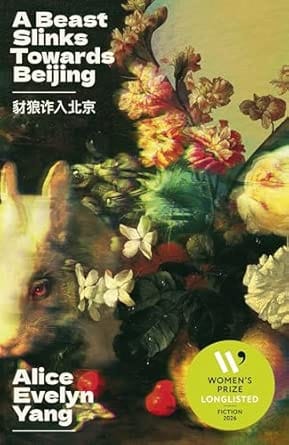
I'm about halfway through Alice Evelyn Yang's A Beast Slinks Towards Beijing and I'm completely absorbed. It's doing several things at once: a dark, magical-realist family saga; a walk through twentieth-century Chinese history from the Japanese occupation of Manchuria and the Cultural Revolution through to the present; and a sustained engagement with folklore, omens, and ghosts that never tips into genre cliché. I'm learning more about the texture of modern Chinese history and folk belief than any textbook has managed, simply because the history is bound to real characters whose lives are shaped and distorted by those forces — the food, the land, the omens, the awful weight of what the twentieth century did to ordinary Chinese families. At the same time the book is sharp on contemporary America — the way immigrant families and their children move between cultures, languages, and expectations, including the slightly brittle, over-performed cleverness of US campus life. It's ambitious, properly uncanny, and so far I haven't wanted to put it down.
Where I Got It
Left for Dead on Wyle Cop in Shrewsbury is the kind of bookshop where someone who has read the books decides which ones to stock, and tells you why. When I went in I didn't browse aimlessly and default to something I'd already heard of; I ended up in a long conversation with the owner and walked out with three books I wouldn't have found on my own: William Burns's Ghost of an Idea: Hauntology, Folk Horror, and the Spectre of Nostalgia, Alice Evelyn Yang's A Beast Slinks Towards Beijing, and Tom Oakley's The Villager. All three came recommended on the basis of obvious, lived familiarity with the territory — folk horror, hauntology, intergenerational trauma, the strange seams where history and the uncanny overlap. This is curation in the old sense: someone who actually reads the material, thinks about it, and puts the right thing in your hand.
What it reminded me of most was a good CAMRA-era real ale pub that survived the keg revolution — the kind of place that kept its own judgement through the decades when every pressure said give in, stock what the brewery tells you to stock, serve what the tied house demands. Left for Dead has that same quality of stubborn, particular independence: small, idiosyncratic, rooted in its place on Wyle Cop, run by someone whose taste you find yourself wanting to trust. If there's any hope for a real resurgence of local book culture, it will come from places like this, where conversation and enthusiasm still shape what ends up on the shelves.
Keep in touch!
Tony