Memories of Ghost-hunting at Charleville Castle, Ireland
Charleville Castle: Ghosts, Druids, and Plumbing from Another Century
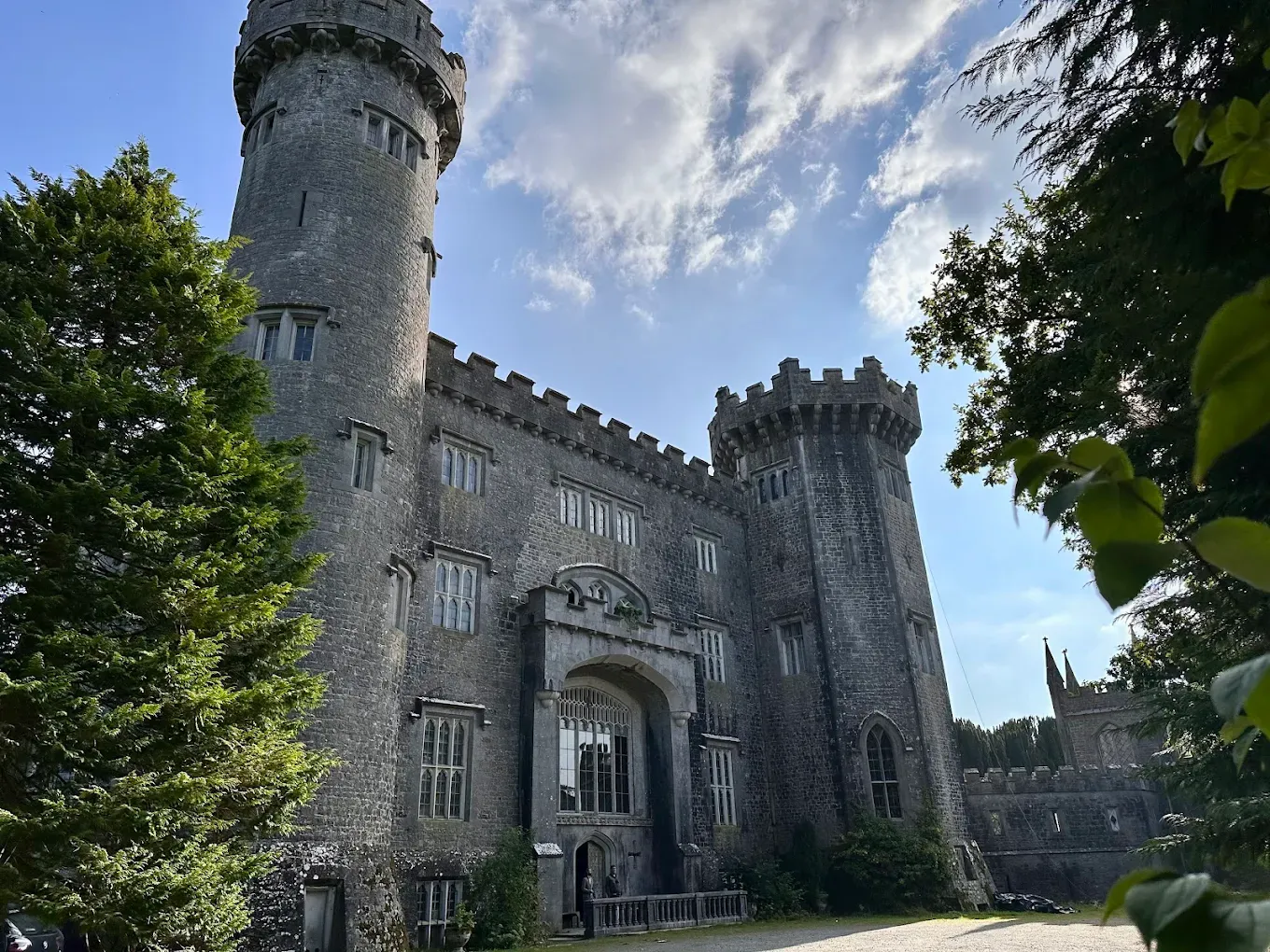
Charleville Castle sits outside Tullamore in County Offaly, in the Irish Midlands. You leave the town behind, turn off the road, and drive in under the oaks along an avenue that cuts through the demesne. At night the trees close over you completely, and the castle appears very late in the sequence: a pale, elaborate bulk rising out of the darkness at the last possible moment. It isn't medieval. It's late-eighteenth and early-nineteenth-century Gothic Revival, Francis Johnston's masterpiece for the Earl of Charleville, designed as a statement of power rather than a fortress. But seen at the end of that drive, with a hint of ground mist and the smell of damp leaves in October, it insists on feeling older than its masonry.
I first went there in the late 1990s because of work, though "work" in this case meant being paid to wander through ruined and half-ruined places in the dark, asking the dead to show themselves. For a few years straddling the turn of the millennium — roughly 1998 to 2004 — I ran ghost tours in England, Ireland, and Scotland: long weekends in draughty houses, overnights in castles that the guidebooks called "atmospheric" and the staff called "bloody freezing." We'd hire a venue, bring a group, and spend the small hours in cellars and attics with torches, thermometers, and the usual array of hopeful equipment. I never managed to organise one in Wales, though the landscape there practically begs for it.
Charleville was one of the places we went back to again and again, and I loved going there. The food was indifferent, the plumbing not quite 20th Century, but the people were wonderful.
The renovation was always visibly in progress, and progress is perhaps a generous word for what we witnessed. Volunteers worked on the roofs with hammers, fixing slates, though they had the look of people who had not previously spent much time on roofs. You got the impression that the castle was being held together by goodwill and improvisation in roughly equal measure, which given its size and condition was actually rather impressive.
On one visit we knocked at the front door and got no answer. We went round the back and found a ladder propped against a window. This seemed, in context, like a reasonable invitation, so we climbed in and found ourselves in the library. An English lord was sitting there with his tie undone and a glass of claret, apparently in the middle of a quiet evening, and he looked up at two people climbing through his window with complete equanimity. He said he was descended from the owners who'd left after Independence. He even offered us a glass. We accepted. It seemed the only sensible response.
That was Charleville's particular quality: nothing that happened there felt entirely surprising, because the place had already established that ordinary expectations didn't quite apply. The plumbing made that fact emphatic from the first morning. Pipes clanked, showers sulked, and hot water was an intermittent rumour. Radiators did their best and rarely won. You adjusted your expectations and kept your coat on indoors.
The owners were relaxed, welcoming, and surprisingly tolerant of groups of strangers turning up with flight cases full of gadgets and a tendency to stay awake until dawn.
One Halloween I was there for a ghost tour but I had my family with me, and we spent the night in one of the tower rooms: a round stone chamber like something out of a fairy tale, a log fire burning in the grate, a bottle of wine, and Jack the black dog, loaned to us for the evening, stretched out in front of the hearth. No ghosts that night. Some of the best nights in haunted buildings are like that.
The owner, Bonnie, told a story that stayed with me. When her son was young he went missing in the castle — the place is vast, a labyrinth of corridors and stairwells and forgotten rooms — and she panicked, as any mother would, and began searching. When she found him he told her not to worry. The little boy and girl had been looking after him. She had never seen any little boy or girl.
Her partner was Mr Dudley, a lovely, welcoming Irishman whose name I have since borrowed for various fictional horror stories. In the flesh he was entirely benign, though a little eccentric. I hope he won't mind me saying that. I'm a bit eccentric myself.
I had my own small moment there, less dramatic but oddly persistent in memory. It wasn't late. I was walking to the toilet when I nearly stepped on something — I was certain there was a cat underfoot. I looked around. There was nothing there. I stood and looked and there was simply nothing. These are the experiences that are hardest to write about because they resist elaboration; something was almost there, and then wasn't, and that's the whole of it. No meaning and no sting in the tale as there certainly would have been if I'd made it up.
The castle has its established stories: a girl who fell, or was pushed, down the great staircase, and whose presence is still reported on the stairs. One Halloween — I had a great many Halloweens in those years, and they blur at the edges — I brought two mediums. It was a large group, so I set them off in opposite directions, each with their own party, to make their way independently through the building. The two of them disliked each other cordially, which made the independent element easy to guarantee. When they came back and reported, both had seen a girl on the staircase. Not near the staircase or around it — on it, at exactly the same point. They hadn't spoken to each other. Given the strength of their mutual antipathy, the possibility of collusion was essentially zero.
There are also supposed to be ghostly druids somewhere in the demesne — figures in the trees, presences in the older parts of the grounds. I never saw any. The forest is ancient enough, and strange enough at night, that I wouldn't entirely dismiss the idea. But Charleville offered me plenty without them: the girl on the stairs confirmed twice over, a child comforted by visitors no one else could see, a near-collision with something that left no trace. In that setting, the paranormal work never felt like entertainment. You were always conscious that the castle had its own long story, and that you were in it only briefly, and only by invitation and that it would go on long after you'd left.
Need Something To Read?
📚 Buy my paperbacks here:
https://books.by/tony-walker-books
🎙️ Buy my ebooks and audiobooks here: