Crewe by Walter de la Mare
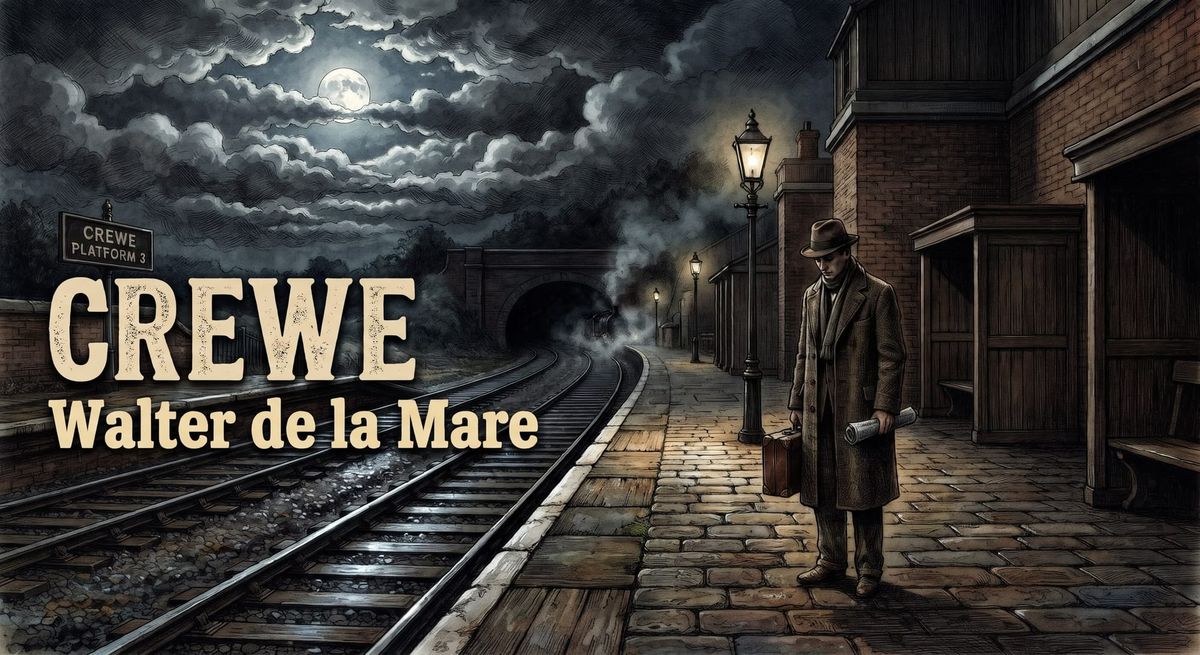
Listen to Crewe by Walter de la Mare
Publication Details
Walter de la Mare’s “Crewe” appeared in Lady Cynthia Asquith’s anthology Shudders (London: Hutchinson, 1929), before being collected in his On the Edge (London: Faber & Faber, 1930). A modern reprint appears in Strangers and Pilgrims, edited by Rosalie Parker, with an introduction by Mark Valentine, first published by Tartarus Press in 2007 and reissued in two slipcased volumes in 2022.
A nocturne in grey
Imagine a painting in the manner of Whistler, one of those nocturnes in which a scene is reduced to a few tones and the viewer has to lean in to find what is there. The palette of “Crewe” is greys and silvers, with a deep black pressing at the edges of the room. The only warmth comes from the dying orange of cinders in an iron grate, which gives just enough light to show two people sitting in a space furnished for no one in particular. Nothing in the picture is vivid, and that restraint makes the one glowing patch of colour all the more noticeable. The fire is on its way out, and a reader senses that whatever happens in the room will happen after it has gone.
The room is the first-class waiting room of a railway station, and it belongs to a category of place that the French anthropologist Marc Augé called “non-places” in Non-lieux: Introduction à une anthropologie de la surmodernité (Paris: Seuil, 1992; translated by John Howe as Non-Places: Introduction to an Anthropology of Supermodernity, London: Verso, 1995). Augé was describing spaces organised around transit, consumption and temporary occupation, which lack the shared identity, history and relationships that make somewhere a place in the fuller human sense. His examples include railway concourses, motorway service stations, airport lounges and the standardised rooms of chain hotels. People pass through as strangers, with little need to know one another or leave any trace of themselves, and they separate again without having belonged to anything. Anyone who has sat alone in a hotel room that could be in any city, or in a service station at three in the morning, will know the sensation of being nowhere in particular, and that sensation is what de la Mare turns into horror.
Crewe suits the purpose well. Its station opened in 1837, and the establishment of the locomotive works in 1843 helped turn the surrounding settlement into a railway town. It became one of the great junctions of Victorian Britain and remains a major interchange today, a place where lines from several directions meet and passengers change trains and wait for connections. The story is therefore set in the most ordinary kind of modern space, among people who have no reason to be there except to be somewhere else. Such a setting allows the uncanny to break through without a ruined abbey or a lonely manor. A first-class waiting room, with its fire and its upholstery and its air of respectability, ought to offer reassurance, and de la Mare makes that reassurance fail. The story suggests that if the supernatural can surface in such a room, it can surface anywhere.
The story and Blake
The narrator of “Crewe” is a traveller waiting for the up train on a winter afternoon, who believes himself alone in the first-class waiting room until a voice speaks out of the gloom behind him. It belongs to Mr Blake, a small man in an overlarge greatcoat who asks for nothing and wants only to talk. The narrator promises to repeat Blake’s story as far as he can in Blake’s own idiom, and he tells it years afterwards, so everything that follows reaches us as his recollection of what a stranger told him in a railway station, with his own questions and, at the very end, a porter breaking in.
Blake’s story concerns his last situation, as a servant to the Reverend William Somers, an elderly clergyman of private means in an isolated country vicarage. The household was small: Blake himself, a young man named George, a woman who came in from the village to cook and clean, and a Scottish gardener, Menzies, who lived at the lodge with his widowed daughter and her small son. The Reverend had remembered his servants in his will, and Blake tells us how he understood it. Each had to be still in service when the old man died, and if any of the others left for any reason, the one remaining was to have everything. Blake adds, in a remark that is easy to pass over, that death was another matter and that he was in error about it. We have the terms only from Blake. The Reverend is failing through the second half of the tale, and what Blake says of his own circumstances afterwards implies that he has died.
What follows is a chain of removals, each presented as an unwelcome duty. Blake quarrels with Menzies over the fruit and over drink, and instead of dealing with the matter himself he sends George to deliver a warning, taking care, as he tells the narrator, not to compromise himself. The warning goes badly. Menzies waylays George by the stables and leaves him marked about the face, the Reverend questions George and dismisses Menzies, and Menzies hangs himself in a barn that night, having said that he would be even with George and, more quietly, with Blake as well. Later, with the Reverend close to death and a scarecrow appearing and vanishing in the stubble field, Blake sends George out into the dark to see what is wrong, sits down on George’s bed to wait, and learns in the morning that George is dead. By the end of the tale Blake is the only servant left.
Greed in this story is small and domestic. There is no grand scheme, only a household waiting at a deathbed and a man who understands the arithmetic better than the others, since each departure brings the survivor closer to the whole estate. Blake never says that this is what he wants. He speaks instead of peace and quietness, of keeping an easy face to everyone, and of how a decent man could have done no differently. The pattern is that of a passive-aggressive narcissist, someone who gets what he wants by arranging for weaker people to take the risks and then stands apart from the damage. The will explains why he behaves as he does, and what remains to be explained is how he can do it and still think well of himself.
The answer can be read in five layers, like an onion.
The outermost is the persona he offers the narrator, a modest and respectable servant who wants only peace.
Beneath it lies a poisonous manipulator, who uses people and discards them when they stand in his way.
The third layer is dissociative. A man who looked squarely at the second layer would have to live with what he is, and Blake appears to hold it at a distance, so that in his own mind he is the first layer and nothing else. This matters for how we judge him, because someone who has genuinely split off his own malice is hard to call simply wicked.
Under the dissociation sits a possible recognition of guilt that cannot be admitted as guilt and comes out as compulsion. The story Blake tells represents him as the first layer and not guilty of anything, and he seems to need it to be believed. When he reaches the quarrel at the pantry window he stops to put it to the narrator, as a free witness, what else he could have done. He insists that a man may have not one iota of harm to blame himself for, and in the same breath he fears that those who were deceived by a misunderstanding may be waiting for him in the next world. He also remarks that going back over the past clears everything up, at least for the time being, and a clearing that lasts only for the time being would explain why the telling has to be repeated. The porter greets him as an old acquaintance, so Blake is evidently a regular in this room. The insistence on his innocence is the sign that part of him may know otherwise.
The fifth layer belongs to the narrator, and it is the truth as he sees it. De la Mare never states it and the narrator never formulates it, but the porter supplies a clue. He comes in to light the gas and rake the fire, greets Blake in the indulgent, bantering tone of a man who has been rewarded for his attentions, and then catches the narrator’s eye with a look full of meaning, as if the two of them shared a private and ironical understanding from which Blake was excluded. The narrator ignores it and leaves.
On reflection I read that look as a verdict on the second layer, the manipulator, although the porter’s knowledge could equally be the kind you have about the lonely regular who tells his story to anyone who will sit still, which would point to the third. The narrator’s last glance back complicates matters further, since Blake watches him go with a mournful look like that of a lost dog, and the narrator’s description of it is a sympathetic one. But what is Blake even doing there at all if not to tell his tale to any who will listen, like a ritual of self-exculpation, that never quite works.
Craft
Everything reaches us through a double filter: a narrator recalling, years after the fact, a story delivered to him by a stranger in a railway station. That voice carries the smooth, over-rehearsed quality of a tale told many times before, polished by repetition and an attempt to manage impressions and guide the listener’s sympathy.
The near-total absence of dialogue tightens this monopoly. By summarising conversations or reporting them second-hand, Blake deprives us of any independent voice—the Reverend’s, George’s, or Menzies’—that might corroborate or more importantly, challenge, his words. Meanwhile, the unhurried pacing allows details to accumulate without ever forcing a dramatic disclosure. Uncertainty is allowed to gather in the corners of the room, and the text never clears it away. He uses stock phrases, drawn from the everyday language of the working class to appeal to our viewpoint narrator's common sense, to suggest him that he and everyone else who was decent would act just like Blake did. Stands to reason, doesn't it?
As well as the characterisation there are the gothic tropes of large, creaky, remote, rural old house, disreputable servants, a large library, but the latter is a hint we are in M R James territory rather than the full gothic of the Castle of Otranto.
The scarecrow is the concrete outcome of this method. Encountered only through Blake’s doubtful testimony, seen across a stubble field as twilight falls, it is an object that may or may not move. Because the restricted perspective denies us any objective view, we cannot securely separate a physical event from an optical illusion, a projection of guilt, or an intentional deceit. The horror resides not in what the figure is, but in our inability to verify what Blake sees.
This scarecrow places “Crewe” directly within the tradition of M. R. James. In Jamesian horror—think of the linen sheet in “Oh, Whistle, and I’ll Come to You, My Lad” (1904) or the changing canvas in “The Mezzotint” (1904)—terror relies on the unsettling transformation of the ordinary, where an apparently inert object occupies a slightly different position every time the observer looks back. A striking modern parallel appears in the Weeping Angels of Doctor Who, introduced by Steven Moffat in “Blink” (2007), where the threat operates on the exact same anxiety: a stone figure that remains immobile while observed, but closes the distance the instant visual contact is broken. In both cases, as with de la Mare’s scarecrow, the dread belongs entirely to the gap between sightings. Yet where James typically confirms the reality of his malice by the end, de la Mare uses the lineage to illuminate the device without ever settling what actually happens in the field.
http://www.tartaruspress.com/de-la-mare-strangers-and-pilgrims.html