- Dec 8, 2025
The Demon King by J B Priestley
- Tony Walker
- 0 comments
Probably the final one in this year's series of Christmas Ghost Stories from The Classic Ghost Stories Podcast.
And what a lot of fun it was.
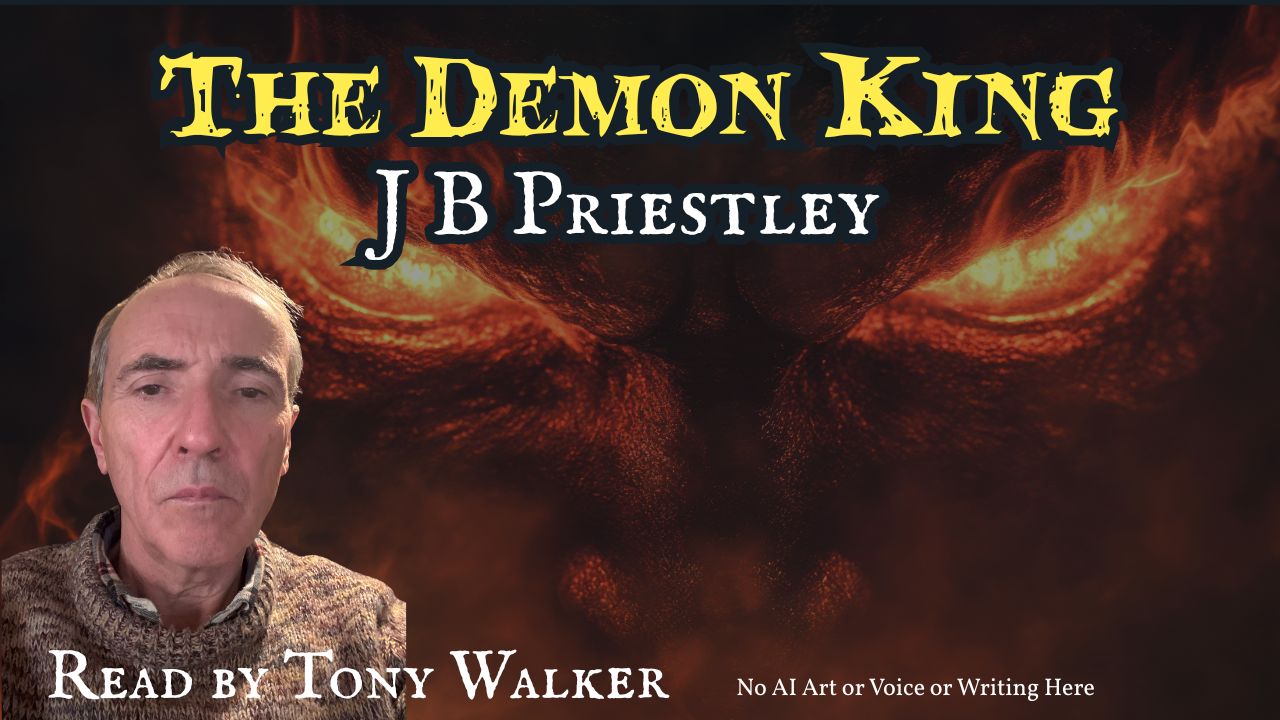
I don't like these new non-AI thumbnails with my fizzog on them. They tell me the illustration is not AI. So it must be the actual devil.
J. B. Priestley and The Demon King
J. B. Priestley knew provincial theatre from the inside. Born in Bradford in 1894, he grew up in a city where music halls and repertory companies were part of the fabric of working life—entertainment for mill workers and clerks, not London critics. Before the First World War interrupted everything, Priestley worked as a junior clerk and spent his evenings writing, but he also spent them in theatres, enjoying the rhythms of Yorkshire speech (who doesn't?) and the particular texture of northern English life: practical, unpretentious, and shot through with a dry humour.
You may not realise that in the North of England, Yorkshirefolk, called politely Tykes, are quite different from Lancastrians. Scousers, Geordies, Mancs, Makkems, Durham folk and the rural Northumbrians. We're all different. Even in Cumbria the West Cumbrians (Marras) are different from Carlisle folk (Castor Oils) are different from Penrithians. Who would have thought such riches were to be found in such a technically small area between Berwick and Hull and Knutsford and Carlisle?
But that being said, I reckon small towns are the same the world over, from Tasmania to Victoria and all points else. Despite that Priestley captures the time and the place so well.
That world—its cadences, its social hierarchies, its small vanities and quiet decencies—runs through all his best work. Priestley became famous for novels like The Good Companions and Angel Pavement, and later for time-slip plays like An Inspector Calls and Time and the Conways. But he never lost his ear for the ordinary voices of provincial England, or his affection for the modest ambitions of people trying to get a show on the road. His wartime BBC broadcasts reached audiences of sixteen million not because he was grand or rhetorical, but because he sounded like someone you might meet in a pub or a railway waiting room—someone who understood what mattered to ordinary people because he'd been one of them.
The Demon King
"The Demon King" is set in Bruddersford on Boxing Night—Priestley's thinly disguised Bradford, a northern mill town where the annual pantomime is less West End spectacle and more a makeshift affair held together by goodwill and stage paint. The company is the usual collection of hopefuls and has-beens: actors who know their lines but not much else, a manager fretting over ticket sales, a prompter with opinions. It's all thoroughly believable, the kind of detail that comes from someone who's actually been backstage in a provincial theatre and noticed how people talk when they're nervous or bored.
The setup is simple: the actor playing the Demon King hasn't arrived, and the curtain's about to go up. Then he does arrive—and from that moment, everything shifts. The performance suddenly has a weight and authority it never possessed in rehearsal. The villain is genuinely frightening. The comedy lands harder. The pantomime's familiar rituals—the Demon King rising from stage left, the battle between good and evil, the transformation scene—take on a quality that no one can quite account for but everyone in the theatre can feel.
Priestley's great conceit is that the Devil himself has decided to take the role. Not to wreak havoc or claim souls, but apparently for the sheer pleasure of a good performance. It's a wonderfully gentle piece of supernatural fiction. No one is harmed. No Faustian bargains are struck. The evening is, by all accounts, a triumph—the best pantomime Bruddersford has ever seen. And then the Demon King departs, leaving behind only a sense of wonder and the faint smell of Brimstone.
What makes the story work is Priestley's refusal to overplay his hand. He doesn't explain too much or underline the strangeness. The Devil, if that's who he is, behaves with perfect professionalism. The cast and crew are ordinary people experiencing something inexplicable, and they respond as ordinary people would—with a mixture of unease, excitement, and the practical concern of whether they'll get paid. It's all very Yorkshire: even the supernatural is expected to turn up on time and do the job properly.
The story was first published in 1931 and adapted for BBC radio in 1962, with Ian Wallace as the mysterious Demon King and sound effects from the Radiophonic Workshop. It captures something essential about Priestley's imagination: his fascination with time, performance, and the uncanny; his democratic instinct that wonder can arrive anywhere, even in a struggling theatre in a northern town; and his deep affection for the people who keep the show going, whether the Devil's in the building or not.
Where to Listen
Link to Podia here, if you've signed up to Podia
If you're on Patreon, then it's
https://www.patreon.com/posts/demon-king-by-j-145382346
If you're on Youtube as a member go there and it will be found
It will be on Apple in due course.